
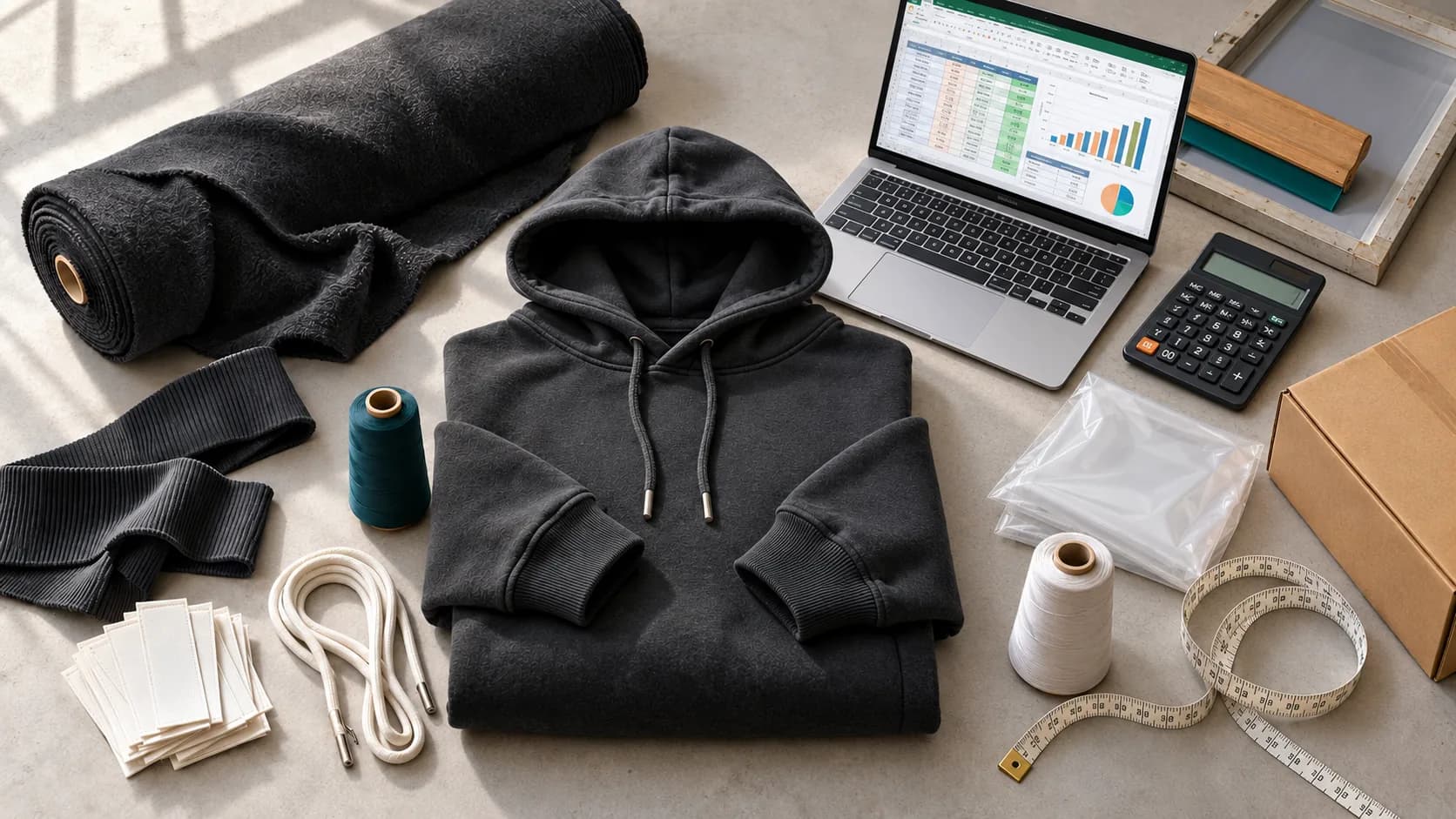
A custom hoodie's price is built from seven lines: fabric, cut-make-trim labour, trims, branding, labels, packaging, and freight and duty. Fabric is usually the largest single line, and it rises with fabric weight (GSM), cotton content and finishing, while small quantities, extra print locations and multiple colours push up the per-piece cost of everything else. The factory (FOB) price is only part of what you pay: landed cost adds freight, duty, taxes and customs clearance.
The seven cost lines at a glance
| Cost line | What drives it | Your biggest lever |
|---|---|---|
| Fabric | Fibre blend, yarn quality, fleece type, GSM, dyeing and finishing | Choose the GSM your customer will notice, not the heaviest available |
| Cut, make and trim (CMT) | Number of sewing operations, fit, size range, order size | Simplify construction details customers never see |
| Trims | Rib, drawcords, aglets, eyelets, zips | Use stock trims; save custom hardware for hero styles |
| Branding | Method, number of colours, stitch count, number of locations | One strong decoration beats four weak ones |
| Labels | Woven or printed neck label, care label, hang tag | A printed neck label costs less than woven and is tagless |
| Packaging | Polybag, folding, tissue, boxes, retail or Amazon prep | Pack for how the garment is sold, not for photos |
| Freight and duty | Courier, air or sea; weight and volume; destination tariffs | Ship by sea when the calendar allows |
Fabric: fibre, fleece type and GSM
GSM is fabric weight in grams per square metre. A heavier fabric puts more material into the same pattern, and knitted fabric in Pakistan is generally bought and sold by the kilogram. So, for the same fabric quality, fabric cost scales roughly with weight: a 400 GSM hoodie uses about a third more fabric by weight than a 300 GSM hoodie cut from the same pattern.
How much fabric a hoodie consumes also depends on the size range (a run heavy in XL and XXL uses more), the fit (oversized and drop-shoulder patterns use more), the hood (a lined hood roughly doubles the hood fabric), pockets, and cutting waste.
Fibre and yarn. 100% cotton generally costs more than cotton-polyester blends such as 80/20 or 60/40, and combed or ring-spun yarns cost more than carded or open-end yarns. Certified organic cotton and recycled polyester carry premiums and need documentation.
Construction. French terry keeps its loops on the inside and skips the brushing step; brushed fleece is brushed to raise a soft pile. Most mid-weight and heavyweight sweatshirt fleece is three-thread fleece.
Dyeing and finishing. A standard colour dyed in the piece is the cheapest option. A custom Pantone match needs a lab dip, and each colour is a separate dye lot with its own minimum, which is why minimums are set per colour. Heather or melange shades use blends of dyed fibres. Garment dyeing, enzyme or acid washes and silicone softeners add a process step, cost, and a shrinkage risk that has to be controlled.
| GSM range | Typical feel and use |
|---|---|
| 280–320 | Lightweight to mid-weight: layering, athletic and warm-climate hoodies |
| 320–360 | Mid-weight: the everyday retail hoodie |
| 360–400 | Heavyweight: premium streetwear, structured drape |
| Above 400 | Extra heavyweight: statement pieces, cold climates, the highest fabric cost |
Cut, make and trim
CMT is the labour and overhead of turning fabric into a finished hoodie: cutting, sewing, finishing, pressing and in-line quality checks. Its cost follows the number of operations. Details that add operations include a three-panel hood instead of two panels, a lined hood, a kangaroo pocket or zip pockets, side panels, a full-length zip, coverstitch details, thumbholes, and embroidered rather than metal eyelets.
Small orders cost more per piece in CMT because setting up a sewing line (training operators on the style, balancing the line, approving first pieces) takes about the same effort for 100 pieces as for 1,000.
Trims
Rib for cuffs and hem, drawcords, aglets (plastic, metal or silicone-dipped), eyelets, and zips on full-zip styles. Branded zips and custom metal aglets can each add noticeably to the unit price, while stock trims in a matching colour usually cost little.
Branding
Branding is usually quoted separately because it varies more than any other line.
| Method | One-time setup | How the unit cost behaves | Best for |
|---|---|---|---|
| Screen printing | A screen per colour per location | Falls quickly as quantity rises | 100+ pieces, spot colours |
| Puff print | Screens plus specialty ink | Higher than flat screen printing | Raised, tactile graphics |
| DTF or DTG | None | Fairly flat per piece | Small runs, full-colour artwork |
| Embroidery | Digitising the logo | Driven by stitch count | Chest logos, sleeves, a premium look |
| 3D puff embroidery | Digitising plus foam | Higher stitch count and slower | Bold raised logos |
| Embossing or debossing | A die or plate | Per-piece pressing | Tonal, premium effects |
| Chenille or appliqué patches | Patch development | Patch cost plus attaching | Varsity styles |
Every extra location adds its own setup and handling, and oversized prints need larger screens and more ink. See our custom branding options for what we run in-house.
Labels and packaging
- Neck label. Woven labels look premium; printed (tagless) neck labels are cheaper and more comfortable.
- Care and content label. Required in most markets: fibre content, country of origin and care instructions, plus dealer identity in the US and Canada.
- Hang tag, attached with string or a pin.
- Packaging. An individual polybag is standard. Folding with tissue or a branded box adds cost and volume, and volume costs money in air freight. Amazon FBA has its own prep and labelling rules, so check Amazon's current requirements before packing.
Quantity: why 100 pieces cost more each than 1,000
On a small order, fixed costs are spread over fewer pieces: pattern grading, marker making, screens or digitising, line set-up, and the dye-lot minimum for each colour. Colour split matters as much as total quantity. Three hundred pieces in one colour cost less per piece than the same 300 split across three colours of 100 each.
Getting a Qumash Lab price for your hoodie
We quote every hoodie on its own spec rather than from a fixed list, because the lines above move the price more than any list can show. Send us the style, GSM, fabric, colours, quantity per colour, branding and destination through our quote form, and we reply within 2 working hours with a per-piece price at 100, 300 and 500 pieces so you can see exactly where the quantity breaks fall.
Samples: your first sample is free and you only pay shipping; complex styles cost $50–150 per style, credited toward your bulk order. Samples take 7–10 business days, and bulk production 15–30 days after sample approval.
A note on the term: FOB applies to sea shipments from a named port. When goods leave by air or courier, the correct Incoterm is FCA.
Freight and duty: from FOB to landed cost
Landed cost per piece is the FOB price plus freight, insurance, import duty and any additional tariffs, customs clearance and brokerage, import VAT or GST where it applies, and delivery to your warehouse.
- Freight. Air and courier shipments are charged on the greater of actual and volumetric weight, and heavyweight hoodies are bulky, so packing density matters. Sea freight is far cheaper per piece but adds weeks.
- Duty. Rates depend on the importing country, the product's tariff classification (HS or HTS code), fibre content and country of origin. US tariffs on apparel imports changed several times in 2025 and 2026, so confirm the current rate for your code with a licensed customs broker before you set a retail price.
- Taxes. Many markets charge import VAT or GST; VAT-registered businesses can often reclaim it.
How much does a box of hoodies weigh?
A hoodie weighs far more than its GSM suggests, because GSM is grams per square metre and a finished adult hoodie uses about 2.5 square metres of fleece plus rib, drawcord and a polybag. Our team weighed a finished 350 GSM pullover hoodie at about 850 g, and we quote shipping on 900 g per piece. Packed weights we use for freight quotes (adult sizes L to XL, one polybag each):
| Pullover hoodie fabric | Packed weight per piece | 100 pieces, including cartons |
|---|---|---|
| 280 GSM French terry | about 0.73 kg | about 75 kg |
| 320 GSM brushed fleece | about 0.83 kg | about 86 kg |
| 350 GSM brushed fleece | about 0.90 kg | about 93 kg |
| 380 GSM brushed fleece | about 0.97 kg | about 100 kg |
| 400 GSM heavyweight fleece | about 1.02 kg | about 106 kg |
If a supplier's courier quote for 100 heavyweight hoodies is based on 35 to 40 kg, it was calculated on GSM instead of garment weight, and the real bill will be more than double.
Seven ways to lower the price without cheapening the hoodie
- Launch with fewer colours per style and add colours once they sell.
- Pick the GSM your customer notices. The jump from 360 to 400 GSM costs fabric; test whether your buyers feel it.
- Use a printed neck label instead of a woven one.
- Keep hidden construction simple and spend on what shows.
- Consolidate branding into one or two strong locations.
- Move up a quantity tier only if you will sell the stock.
- Plan the calendar so bulk can travel by sea.
For bigger runs, see our bulk order service and the hoodie manufacturing page.
Key facts
- Seven cost lines: fabric, CMT, trims, branding, labels, packaging, freight and duty.
- Knitted fabric is priced by weight, so fabric cost rises roughly in line with GSM for the same quality.
- Per-piece cost falls with quantity because setup costs are fixed; colour split matters as much as total quantity.
- Screen printing gets cheaper per piece as quantity rises; DTF and DTG suit small, full-colour runs.
- FOB excludes freight, duty and import taxes; compare suppliers on landed cost.
- A packed 350 GSM pullover hoodie weighs about 0.9 kg, so 100 pieces ship at about 93 kg including cartons.
- Qumash Lab: minimum 50 pcs per style per colour from stock, 150 in your Pantone colour, 200 with your own fabric composition; first sample free (you pay shipping), bulk in 15–30 days after sample approval.
Frequently asked questions
How much does it cost to make a custom hoodie in Pakistan?
It depends mainly on GSM, fibre blend, quantity, colour split and branding, which is why we quote each spec individually. Send your spec through our quote form and we reply within 2 working hours with prices at 100, 300 and 500 pieces.
Does a heavier GSM hoodie cost more?
Yes. Knitted fabric is priced by weight, so for the same quality a heavier fabric costs more per garment, roughly in proportion to the extra weight.
Is screen printing cheaper than DTF for hoodies?
At higher quantities with few colours, screen printing is usually cheaper per piece. At small quantities, or for full-colour artwork, DTF or DTG often wins because there are no screens to make.
Why does the price per hoodie drop at higher quantities?
Sampling, grading, marker making, screens, digitising and line set-up cost about the same whether you order 100 or 1,000 pieces, so a larger order spreads them thinner.
Does the FOB price include shipping and duty?
No. FOB covers the goods cleared for export and loaded at the named port. Freight, insurance, import duty, taxes and delivery are added on top unless you buy on DDP terms.
Is the sample free?
Your first sample is free and you only pay shipping. Complex styles cost $50–150 per style, credited toward your bulk order, and samples take 7–10 business days.