
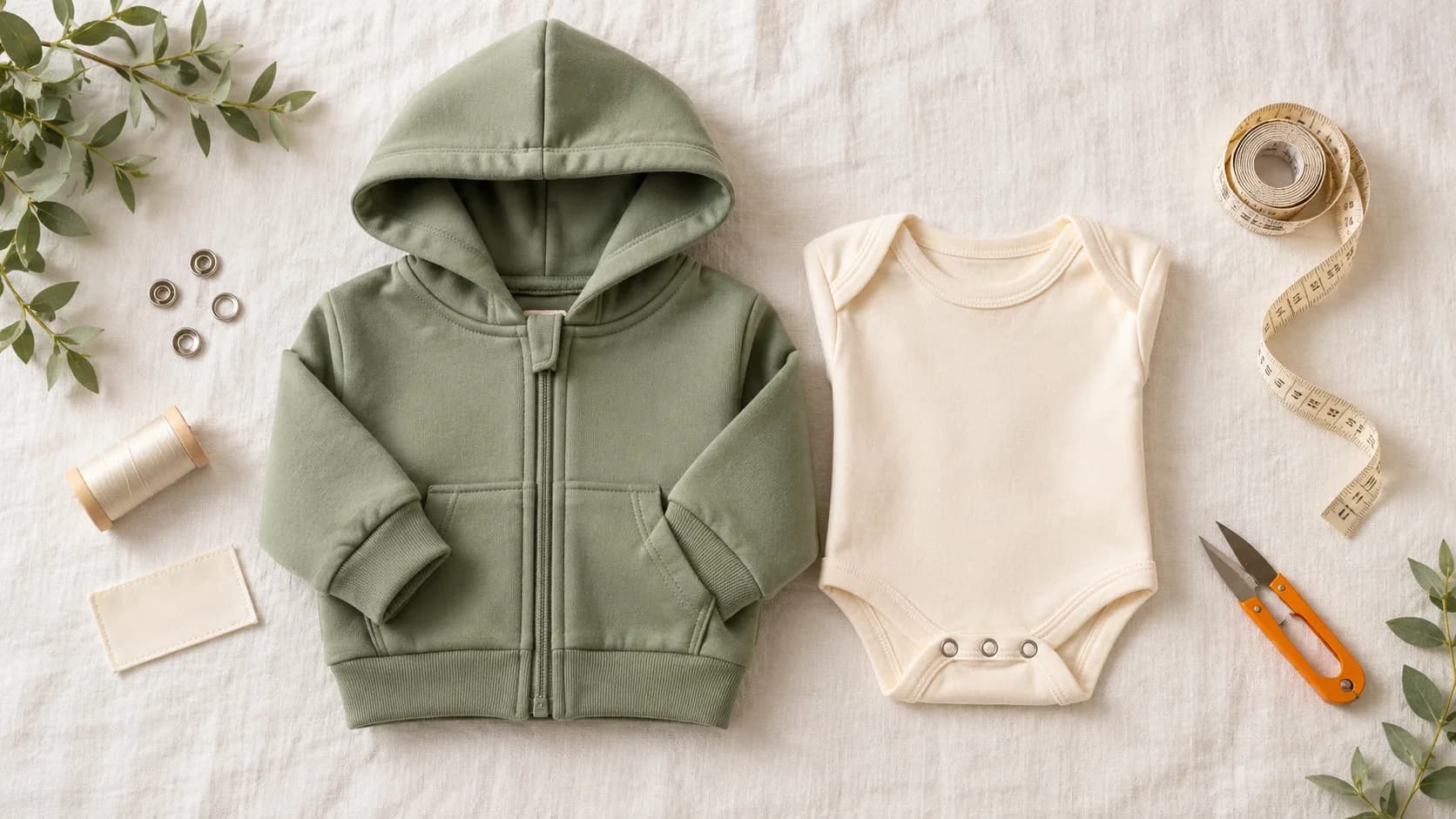
Most safety problems in children's clothing are designed in, not sewn in, so they are cheapest to fix at the sketch stage. The four big risks are cords and drawstrings that can catch and strangle (not allowed in the hood and neck area for young children in the US and EU), small parts that can come off and be swallowed (snaps, buttons, appliqués, rhinestones), loops and long ties that can trap a finger or a limb, and sharp or scratchy parts such as zip ends and hard labels. Design them out first, then prove the design with lab pull tests on the pre-production sample.
Who this applies to
- Babies and toddlers (under 3 years): the strictest group, because they put things in their mouths and cannot free themselves when caught.
- Young children (about 3 to 7): cords and drawstrings at the hood and neck are the main concern.
- Older children (about 7 to 14): cords are allowed only within tight limits.
In the US, a children's product is one designed mainly for children aged 12 or under. The European standard for cords and drawstrings, EN 14682, covers children's clothing up to age 14. Legal certificates and labels such as CPSIA, OEKO-TEX and GOTS are a separate subject; this guide is about the garment design itself.
The rules at a glance
| Hazard | United States | EU and UK | What to do in the design |
|---|---|---|---|
| Drawstrings at the hood and neck | Treated as a substantial product hazard on children's upper outerwear in sizes 2T to 12 (16 CFR Part 1120) | Not allowed for young children; strictly limited for older children up to 14 (EN 14682) | Fixed hood with no cord; use a flat elastic or a sewn-down decorative tape for the look |
| Drawstrings at the waist and hem | Sizes 2T to 16 must meet ASTM F1816-97: short exposed ends, no toggles or knots on the ends, bar-tacked in the middle | Length limits and no toggles on free ends (EN 14682) | Short ends, stitched at centre back so they cannot be pulled out on one side |
| Small parts that can detach | Detachable parts on products for children under 3 are a recognised choking hazard and a common cause of recalls | Covered by general product safety law, with design guidance in CEN/TR 16792 and, in the UK, BS 7907 | Secure attachment, pull-tested; avoid loose decorations on babywear |
| Lead in trims and prints | Limits for children's products, tested by an accepted lab | Chemical limits under REACH | Use trims and inks with current test reports |
Cords and drawstrings
Cords on children's clothing can catch on playground slides, bus doors and fences. That is why the rules are strict.
- Hood and neck: no drawstrings or functional cords on garments for young children. For a hoodie, use a fixed hood. If you want the look of a drawcord, sew a short flat tape down along its length so it cannot be pulled out or looped.
- Waist and hem: keep exposed ends short, with no toggles, knots, beads or 3D ends. Bar-tack the cord at its midpoint (usually centre back) so it cannot be pulled through to one side.
- Ties, sashes and belts: limit the length and attach them firmly. Long ties at the back of a dress or apron are a catch hazard.
- Loops: avoid loops large enough to trap a finger, a hand or a head, including hanger loops on the outside of the garment.
The EU standard EN 14682 sets detailed lengths for different areas of the garment and different ages. If you sell in Europe, share it with your factory before sampling.
Snaps, buttons and other small parts
A snap or button that comes off a baby's bodysuit is a choking hazard. Getting snaps right is about the whole system, not just the snap:
- Use quality snaps, preferably nickel-free metal or good plastic, from a supplier who can give test reports.
- Match the snap size to the fabric thickness, so the prongs grip properly.
- Reinforce the area with a strip of interfacing or a double layer of fabric. Snaps on a single layer of thin jersey pull out.
- Calibrate the snap press and check the first pieces of every batch.
- Pull test them. Snap attachment strength is measured with test methods such as ASTM D4846. Many European buyers use 90 newtons held for 10 seconds as their pass mark, a figure borrowed from the toy safety standard EN 71-1. Check your buyer's own manual, which sets the number you must meet.
For buttons, sew with strong thread and a locked stitch, and test them the same way. Many babywear brands avoid buttons on garments for the first year and use snaps or envelope shoulders instead.
Appliqués, prints and decorations
- No loose decorations on babywear: beads, sequins, rhinestones, pom-poms and glued-on gems can come off and be swallowed. Use embroidery or print to get the same effect.
- Bows and 3D decorations: bar-tack them through the fabric, and include them in the pull test.
- Heat transfers and patches: test that they do not peel after washing.
- Inks: use inks with current test reports for children's products. In the US, lead limits apply to prints and coatings on children's products.
Zips
- Add a zip garage: a small fabric flap at the top of the zip that covers the zip end and protects the chin and neck.
- Secure the puller: pullers must not detach. Avoid long or decorative pullers on toddler clothes.
- Smooth ends: no sharp metal edges at the top or bottom stops.
- Choose the right zip: a moulded plastic zip is lighter and softer for small children than a heavy metal one.
Neck openings and head size
Children have large heads compared with their bodies. A neck opening that is too small turns dressing into a struggle and strains the seams.
| Age | Typical head circumference |
|---|---|
| Newborn | about 34 to 35 cm |
| 1 year | about 45 to 46 cm |
| 2 years | about 47 to 48 cm |
| 5 years | about 50 to 51 cm |
Check that the stretched neck opening of every size comfortably passes over the head size for that age. For babies, use envelope (lap) shoulders or shoulder snaps so the garment can also be pulled down over the body, which is how parents remove a soiled bodysuit.
Threads, seams and labels
- Trim loose threads, especially inside feet, mittens and footed sleepsuits. A loose thread can wrap tightly around a tiny toe or finger.
- Use flat, soft seams next to the skin, and avoid thick, hard seam allowances.
- Choose soft labels: printed (tagless) labels, or soft woven labels in the side seam rather than a scratchy one at the neck.
- Elastic: covered elastic, not too tight. Check it does not leave marks on the skin.
A note on sleepwear
In the US, children's sleepwear has much stricter flammability rules than day clothing. Garments sold or styled as pyjamas or nightwear must either pass those tests or meet the tight-fitting requirements, with the required labels. If your range includes loungewear, check with your lab before you call it sleepwear on the label or the product page.
The design checklist
Copy this into your tech pack for every kids style:
- Age range and target market written on the tech pack
- No drawstrings or cords at the hood or neck
- Waist cords: short ends, no toggles, bar-tacked at centre back
- Ties, sashes and loops within length limits
- All snaps reinforced and specified with supplier and size
- Snap and button pull test planned on the pre-production sample
- No beads, sequins, rhinestones or glued decorations on babywear
- Zip garage at the top of every zip
- Neck opening checked against head size in every size
- Soft, flat seams and soft labels next to the skin
- Loose thread check inside feet and mittens
- Inks, prints and trims with current test reports
- Sleepwear rules checked if the item could be sold as nightwear
How we work with kids lines
Tell us your customer's age range and your market when you request a quote. We review the design against these points before the first sample, so the pre-production sample can go straight to the testing lab without a redesign. Our MOQ is 50 pieces per style per colour from stock, sizes can be mixed, and your first sample is free (you only pay shipping). See our page for kids clothing brands, our kids clothing range, and the kids size chart guide, or request a quote.
This guide explains common practice and the main rules in plain language. It is not legal advice; confirm the exact requirements for your product with your testing lab or a compliance specialist.
Key facts
- Hood and neck drawstrings are not allowed on young children's clothing in the US (sizes 2T to 12 upper outerwear) or under EN 14682 in Europe.
- US waist and hem drawstrings on sizes 2T to 16 must meet ASTM F1816-97: short ends, no toggles, bar-tacked in the middle.
- Detachable small parts on clothes for children under 3 are a choking hazard; reinforce and pull test snaps and buttons.
- Many European buyers use a 90 N, 10-second pull as the pass mark for snaps, borrowed from the toy standard EN 71-1.
- Use a zip garage, soft labels and flat seams; trim loose threads inside feet and mittens.
- A 1-year-old's head is about 45 to 46 cm around, so neck openings must stretch well.
Frequently asked questions
Are drawstrings allowed on kids hoodies?
Not at the hood or neck for young children. In the US, hood and neck drawstrings on children's upper outerwear in sizes 2T to 12 are treated as a substantial product hazard, and EN 14682 rules them out for young children in Europe. Use a fixed hood.
How strong should snaps be on baby clothes?
Your buyer or market sets the exact number. A common European pass mark is 90 newtons held for 10 seconds without the snap coming off, and the snap area should be reinforced so it reaches that.
Can baby clothes have buttons?
Yes, if they are sewn securely and pass a pull test. Many babywear brands still prefer snaps or envelope shoulders for the first year because they are faster for parents and easier to secure.
What age counts as a children's product?
In the US, products designed mainly for children aged 12 or under. The EU cords and drawstrings standard EN 14682 covers children's clothing up to age 14.
Do I need to test every size?
Pull tests are normally done on the trims and the way they are attached, so testing a representative size is common. Ask your lab what it needs for your range.
Is a zip safe on a toddler hoodie?
Yes, with a zip garage at the top, a secure puller with no long decorative ends, and smooth stops at both ends.