
Introduction
You've finalized your hoodie design. Bold graphics, multiple colors, intricate details. Now your manufacturer asks: "Screen print, DTG, or digital?"
Pick wrong, and you'll either pay too much per unit, get prints that crack after five washes, or receive colors that look nothing like your mockups.
Print method isn't just a technical decision — it affects your cost structure, minimum orders, design possibilities, and ultimately how customers perceive your brand quality.
This guide breaks down every major printing method, explains when each makes sense, and helps you choose the right technique for your specific products and business model.
Why Print Method Matters
Before comparing methods, understand what's at stake:
- Cost Per Unit — Some methods cost $1 per print, others cost $8. At scale, this difference is enormous.
- Minimum Orders — Some methods require 100+ pieces to be economical. Others work for single units.
- Color Limitations — Some methods handle unlimited colors. Others charge per color.
- Design Complexity — Photographic images, gradients, and fine details work on some methods, not others.
- Durability — Some prints last 100 washes. Others crack and fade quickly.
- Feel — Some prints sit on top of fabric. Others become part of the fabric.
- Fabric Compatibility — Some methods work on any fabric. Others are limited to specific materials.
Let's examine each method in detail.
Screen Printing: The Industry Workhorse
What It Is
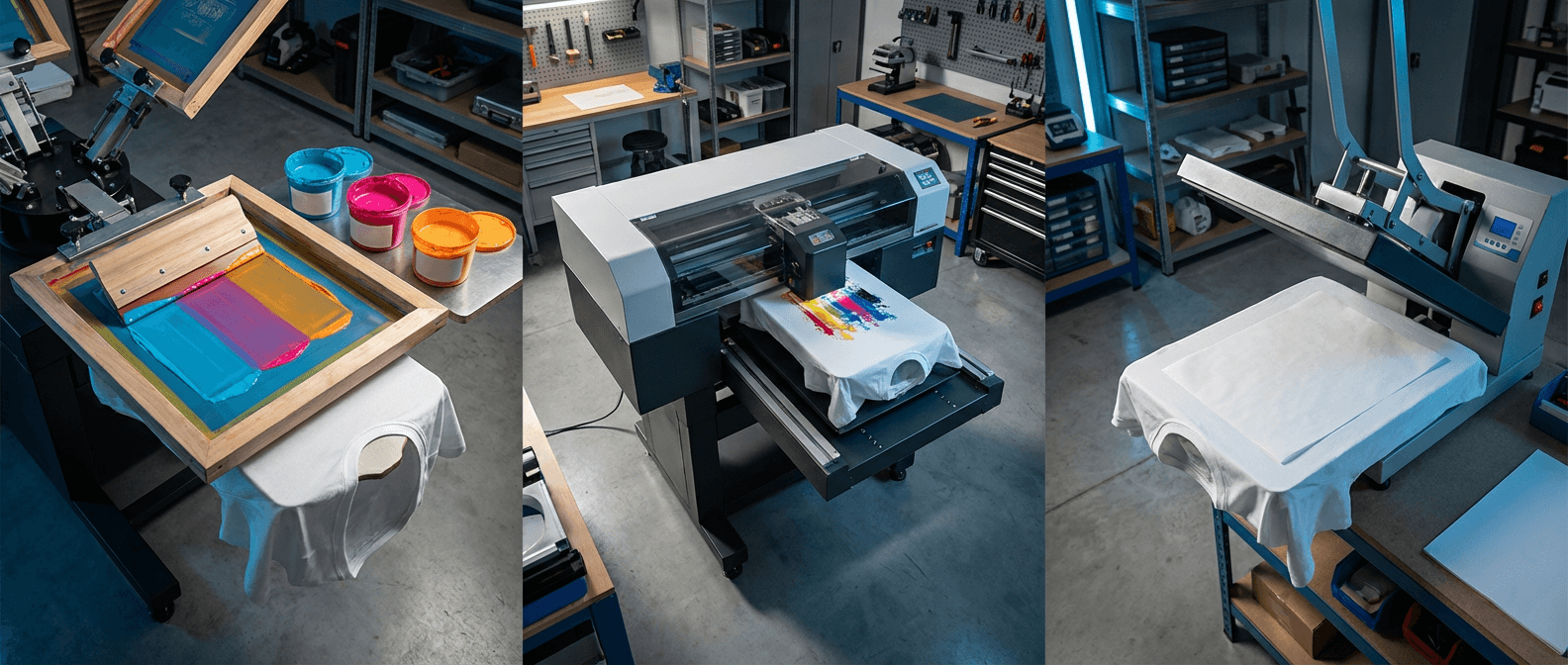
Screen printing (also called silk screening) is the traditional method used for decades. Ink is pushed through a mesh screen with a stencil of your design, depositing ink directly onto the fabric.
The Process
A separate screen is created for each color in your design. Ink is placed on the screen. A squeegee pushes ink through the mesh onto the fabric. The process repeats for each color, with precise alignment between screens. The printed garment is heat-cured to set the ink permanently.
Characteristics
- Best for: Large orders, simple designs, bold graphics, 1-4 colors.
- Color capacity: Each color requires a separate screen. Most shops handle 1-8 colors economically.
- Detail level: Good for bold graphics, limited for fine details and gradients.
- Durability: Excellent — properly cured screen prints last the life of the garment.
- Feel: Ink sits on top of fabric with slight texture. Water-based inks feel softer than plastisol.
- Fabric compatibility: Works on cotton, polyester, and blends. Different inks for different fabrics.
Cost Structure
- Setup cost: $20-50 per screen (per color). A 4-color design needs 4 screens = $80-200 setup.
- Per-unit cost: $1-4 depending on colors and complexity. Decreases significantly at higher volumes.
- Break-even point: Usually 24-50 pieces per design to justify setup costs.
Pros
Industry-proven durability. Vibrant, opaque colors especially on dark fabrics. Low per-unit cost at volume. Wide color matching capability (Pantone matching). Handles specialty inks (metallic, glow-in-dark, puff print).
Cons
High setup costs for multi-color designs. Not economical for small quantities. Limited ability to print gradients and photographs. Each color adds cost and complexity. Design changes require new screens.
Best For
Brands ordering 50+ pieces per design. Designs with 1-4 solid colors. Bold graphics and logos. Streetwear and promotional products. Long-term designs that won't change frequently.
Our Recommendation
Screen printing is your go-to for volume orders with straightforward designs. If you're ordering 100+ pieces of a 2-color logo tee, screen printing delivers the best combination of quality, durability, and cost.
DTG (Direct-to-Garment): The Digital Revolution
What It Is
DTG printing uses specialized inkjet printers to spray ink directly onto fabric, similar to how a paper printer works. It's the newest major print technology and has transformed low-volume custom printing.
The Process
The garment is pre-treated with a solution that helps ink bond to fibers. The garment is loaded onto the printer platen. Inkjet heads spray water-based ink directly onto the fabric in your exact design. The print is heat-cured to set permanently.
Characteristics
- Best for: Small orders, complex designs, photographs, unlimited colors.
- Color capacity: Unlimited — prints from digital files like a photo printer.
- Detail level: Excellent — handles photographs, gradients, and fine details beautifully.
- Durability: Good with proper pre-treatment and curing. Slightly less durable than screen printing.
- Feel: Soft hand-feel — ink absorbs into fabric rather than sitting on top.
- Fabric compatibility: Best on 100% cotton. Challenging on polyester and dark fabrics.
Cost Structure
- Setup cost: Minimal to none — prints directly from digital file.
- Per-unit cost: $5-15 depending on print size and detail. Cost remains relatively flat regardless of quantity.
- Break-even point: Immediately economical for 1-50 pieces. Screen printing becomes cheaper above 50-100 units.
Pros
No minimum order — print one piece economically. Unlimited colors at no extra cost. Perfect for photographs and complex artwork. No setup fees or screen charges. Easy design changes between orders. Soft hand-feel on finished print.
Cons
Higher per-unit cost than screen printing at volume. Less vibrant on dark fabrics (requires white underbase). Best results on 100% cotton only. Print durability slightly lower than screen printing. Slower production speed than screen printing. White ink coverage challenges on dark garments.
Best For
Brands testing new designs before committing to volume. Print-on-demand and made-to-order business models. Designs with many colors, gradients, or photographs. Small batch limited edition releases. Personalized or customized products.
Our Recommendation
DTG is ideal when you're starting out, testing designs, or running a print-on-demand model. It eliminates the risk of holding inventory on unproven designs. Once a design proves successful and you're ordering 100+ consistently, consider switching to screen printing for better margins.
Heat Transfer: The Versatile Middle Ground
What It Is
Heat transfer involves printing your design onto special transfer paper or vinyl, then using heat and pressure to transfer that design onto the fabric.
Types of Heat Transfer
- Vinyl Transfer (HTV): Design is cut from colored vinyl sheets and heat-pressed onto fabric. Best for simple text and basic shapes.
- Digital Heat Transfer: Design is digitally printed onto transfer paper, then heat-pressed onto garment. Handles complex images.
- DTF (Direct-to-Film): Newer technology — design is printed onto special film with adhesive powder, then transferred to any fabric color. Combines DTG quality with broader fabric compatibility.
Characteristics
- Best for: Medium complexity designs, small-medium orders, versatile fabric types.
- Color capacity: Unlimited for digital transfers, limited for vinyl.
- Detail level: Good to excellent depending on transfer type.
- Durability: Good — varies by transfer quality and application.
- Feel: Sits on top of fabric with noticeable texture. Some transfers feel plasticky.
- Fabric compatibility: Excellent — works on cotton, polyester, blends, and performance fabrics.
Cost Structure
- Setup cost: Low to none for digital transfers. Vinyl requires cutting setup.
- Per-unit cost: $3-10 depending on transfer type and size.
- Break-even point: Economical from 1 piece up to medium volumes.
Pros
Works on virtually any fabric type and color. No minimum orders for most transfer types. Good color vibrancy on dark fabrics. Lower equipment investment than DTG. DTF specifically offers DTG-quality on any fabric.
Cons
Transfer feel can be noticeable (less breathable). Durability varies significantly by quality. Edges can peel over time if low quality. Some transfers crack with stretching. Production speed limited by press time.
Best For
Brands needing prints on polyester or performance fabrics. Small orders where DTG isn't suitable for fabric type. Designs requiring vibrant colors on dark garments. Quick turnaround needs. DTF specifically for best quality-to-versatility ratio.
Our Recommendation
Heat transfer, especially DTF, is excellent when you need to print on fabrics that don't work well with DTG (polyester, blends, performance materials). For cotton basics, DTG or screen printing usually delivers better results.
Embroidery: The Premium Alternative
What It Is
Not technically "printing," but embroidery is a major decoration method worth comparing. Thread is stitched directly into the fabric creating a textured, dimensional design.
Characteristics
- Best for: Logos, text, premium positioning, corporate wear.
- Color capacity: Limited by thread changes — typically 1-8 colors practical.
- Detail level: Limited — small text and fine details don't translate well.
- Durability: Exceptional — will outlast the garment itself.
- Feel: Raised, textured, dimensional. Unmistakably premium.
- Fabric compatibility: Works on most fabrics. Best on structured materials.
Cost Structure
- Setup cost: $20-50+ for digitizing (converting design to stitch file).
- Per-unit cost: $3-15+ depending on stitch count and complexity.
- Break-even point: Usually 12-24 pieces to justify digitizing cost.
Best For
Polo shirts and corporate wear. Hat and cap decoration. Premium brand positioning. Simple logos and text. Products where durability is paramount.
Our Recommendation
Embroidery communicates premium quality instantly. If you're selling $50+ polos or positioning as a luxury brand, embroidery adds perceived value that justifies higher pricing.
Comparison Table
FactorScreen PrintDTGHeat TransferEmbroideryMin Order24-50 pcs1 pc1 pc12-24 pcsSetup CostHighNoneLowMediumPer-Unit (Volume)$1-3$5-12$3-8$5-15ColorsLimitedUnlimitedUnlimitedLimitedDetail LevelMediumExcellentGoodLowDurabilityExcellentGoodGoodExcellentFeelOn topSoftOn topRaisedBest FabricAllCottonAllStructuredComplex ArtNoYesYesNoPhotosNoYesYesNo
Decision Framework: Choosing Your Method
Step 1: Assess Your Design
- Simple logo, 1-3 colors, bold graphics? → Screen Printing or Embroidery
- Complex artwork, many colors, gradients, photos? → DTG or Heat Transfer
- Text-heavy or simple shapes? → Vinyl Transfer or Embroidery
Step 2: Consider Your Quantity
- 1-50 pieces: DTG or Heat Transfer (avoid screen printing setup costs)
- 50-200 pieces: Either DTG or Screen Printing depending on design complexity
- 200+ pieces: Screen Printing for simple designs (best economics)
Step 3: Evaluate Your Fabric
- 100% Cotton: All methods work, DTG gives softest feel
- Polyester/Blends: Screen Printing, Heat Transfer, or DTF (avoid standard DTG)
- Performance Fabric: Heat Transfer or DTF only
Step 4: Factor in Business Model
- Testing new designs: DTG (no minimums, no risk)
- Proven designs at scale: Screen Printing (best margins)
- Print-on-demand: DTG or DTF
- Premium positioning: Embroidery
Step 5: Calculate True Costs
Don't just compare per-unit price. Calculate:
Setup costs ÷ order quantity + per-unit cost = true cost per piece
Example:
- Screen print: $100 setup + ($2 × 100 pieces) = $300 total = $3/piece
- DTG: $0 setup + ($8 × 100 pieces) = $800 total = $8/piece
Screen printing wins at 100 pieces. But at 20 pieces:
- Screen print: $100 setup + ($2 × 20) = $140 total = $7/piece
- DTG: $0 setup + ($8 × 20) = $160 total = $8/piece
Much closer — and DTG offers unlimited colors while screen print charges per color.
Common Mistakes to Avoid
Mistake 1: Choosing DTG for Volume Orders
If you're ordering 500 pieces of a 2-color design, screen printing will cost a fraction of DTG. Don't overpay for flexibility you don't need.
Mistake 2: Choosing Screen Print for Complex Art
If your design has 12 colors and gradients, screen printing either can't do it or will charge enormously. Use DTG or digital transfer instead.
Mistake 3: Ignoring Fabric Compatibility
DTG on polyester = disappointment. Heat transfer on high-stretch fabric = peeling. Match method to material.
Mistake 4: Forgetting Feel
Screen print plastisol ink feels thick. DTG feels soft. Embroidery feels raised. The tactile experience matters to customers. Sample before committing.
Mistake 5: Not Sampling First
Always request printed samples before bulk production. Colors, placement, and feel can differ from expectations. A $30 sample prevents a $3,000 mistake.
Working with Qumash Lab
We offer all major print methods discussed in this guide:
- Screen Printing: Our specialty for bulk orders. We handle up to 8-color designs with Pantone matching, water-based and plastisol inks, and specialty finishes.
- DTG Printing: Available for small batches, samples, and complex artwork. Best results on our cotton fabrics.
- Heat Transfer & DTF: For polyester, blends, and performance fabrics where other methods fall short.
- Embroidery: For premium positioning, corporate wear, and logos that demand dimensional quality.
When you request a quote, share your design and we'll recommend the optimal print method based on your artwork complexity, order quantity, fabric choice, and budget. We'll also provide printed samples so you can evaluate quality before committing.
Conclusion
There's no universally "best" print method — only the best method for your specific situation.
The decision framework is simple:
For volume orders with simple designs, screen printing delivers unbeatable economics and durability. For small orders, complex designs, or testing new products, DTG eliminates risk and setup costs. For challenging fabrics like polyester, heat transfer and DTF fill the gap. For premium positioning, embroidery communicates quality instantly.
Match your method to your design, quantity, fabric, and business model. When in doubt, sample multiple methods and let the results guide your decision.
Not sure which print method fits your project? Send us your design and order details. We'll recommend the optimal method and provide samples so you can compare quality firsthand.
This article is part of Qumash Lab's Manufacturing Guides series, helping brands make informed production decisions.