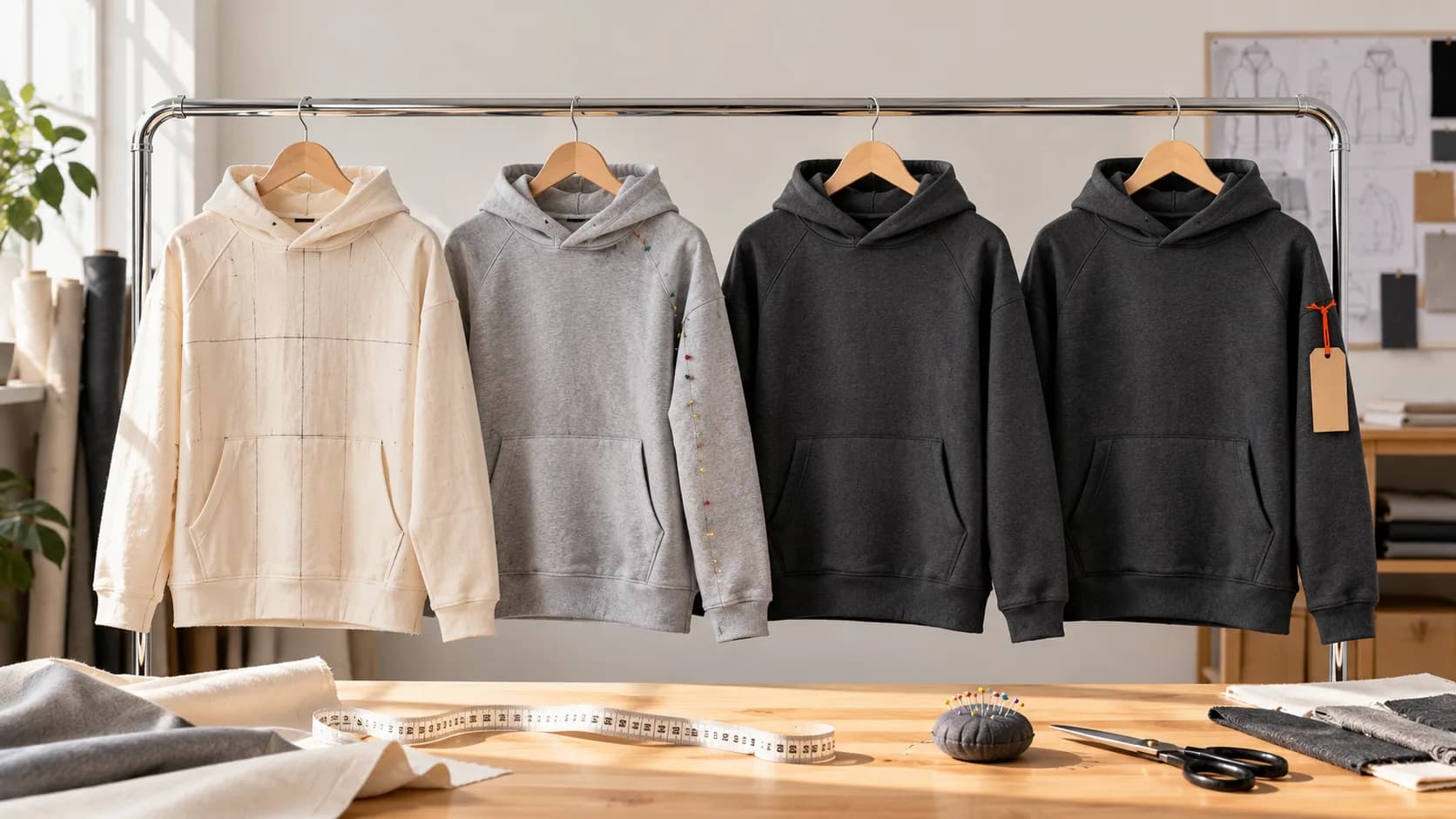
Apparel samples come in stages, and each stage approves something different. A proto sample checks the idea and the construction. A fit sample checks the measurements on a body. A size set checks the grading across sizes. A pre-production (PP) sample is made in the real bulk fabric, colour and trims, and becomes the standard the whole order is judged against. A top-of-production (TOP) sample is taken from the bulk line to confirm it matches. Small brands rarely need all of them: most need one or two development rounds and a PP sample.
The sample stages at a glance
| Sample | What it approves | Made in | When | Typical rounds |
|---|---|---|---|---|
| Proto (development) | The design and the construction | The closest available fabric and trims | First | 1 to 3 |
| Fit sample | Measurements and fit in the base size | The right fabric or a very close one | After the proto | 1 to 2 |
| Size set | Grading across the size range | Close or bulk fabric | Before the PP, for wide size ranges | 1 |
| Salesman or photo sample | Selling, pre-orders, product photos | Close or bulk fabric | Before bulk | As many as you need |
| Lab dip, strike-off, trim card | Colour, print and trims | Bulk fabric, ink and trims | Alongside the other samples | 1 to 3 |
| Pre-production (PP) | Everything, as the bulk will be | Bulk fabric, colour, trims, labels and print | Just before cutting | 1 |
| TOP sample | Bulk matches the PP | Pieces pulled from the first bulk output | Early in production | 1 |
Proto sample: does the idea work?
The proto, also called the first sample or development sample, turns your sketch or tech pack into a real garment for the first time. Its job is to answer basic questions. Does the hood sit right? Is the pocket in a sensible place? Does the print size look right on the chest? Does the construction work?
Because the proto is about the idea, it is normally made in the closest fabric the factory already has, not in your final fabric. Do not judge colour or hand feel on a proto unless that was agreed. Judge shape, proportion, construction and details.
Fit sample: does it fit a real body?
The fit sample is made in your base size (often M for adults, or a middle size for kids) and checked against your measurement spec. A good fit session has three parts:
- Measure. Lay the sample flat and measure every point in your spec sheet: chest, body length, sleeve length, shoulder, hem, neck opening. Compare each to the spec and its tolerance.
- Try it on. Put it on a person or a fit form of the base size. Raise the arms, sit down, bend over, reach forward. Look for pulling, gaping and twisting.
- Wash it. Wash and dry the sample the way your customer will, then measure again. Fit that only works before the first wash is not fit. Our fabric shrinkage guide explains what to expect.
Write every change as a measurement ("increase body length by 2 cm"), not as a feeling ("make it longer").
Size set: does every size work?
A size set is the same style made in several sizes, usually the smallest, the base and the largest, or the full run for a new range. It checks grading, which is the way the pattern grows from one size to the next. Grading mistakes show up at the ends of the range: an XS with a neck too tight to pull over the head, or an XXL with sleeves far too long. For kids ranges, where body proportions change a lot between ages, a size set is strongly recommended. Our kids size chart guide explains why.
Salesman and photo samples
Salesman samples (SMS) are extra pieces made to sell the style before bulk: for showrooms, wholesale buyers, crowdfunding or product photography. They should look like the final product, so they are usually made after the fit is approved. Order them early if you plan to take pre-orders, because your photos and your launch date depend on them.
Lab dips, strike-offs and trim approvals
These are not garments, but they are samples, and they run alongside the garment samples:
- Lab dip: a swatch of your fabric dyed to match your colour standard. See our guide to lab dips and Pantone colour matching.
- Strike-off: your print or embroidery run on the real fabric, to approve colours, size and placement.
- Trim card: a card with the real zips, cords, buttons, rib, labels and hang tags attached.
Approving these in parallel saves weeks, because the PP sample can then be made in one go.
The pre-production (PP) sample: the one that matters most
The PP sample is the most important sample in the process. It is made with the bulk fabric, the approved colour, the real trims, the real labels and the real print, using the production pattern. Once you approve it, it becomes the sealed sample: one piece is kept by you and one by the factory, both tagged as approved, and the whole order is inspected against it.
Approve a PP sample in one of three ways:
- Approved: go ahead with bulk.
- Approved with comments: go ahead, with small written corrections that bulk must include.
- Rejected: a new PP sample is needed before cutting.
If your style uses a fabric that has to be knitted or dyed specially for you, the PP sample has to wait for that fabric. Our guide on ordering small quantities in your own fabric blend explains how to approve fit and fabric separately so this wait does not cost you weeks.
TOP and shipment samples
A TOP (top of production) sample is taken from the first finished pieces off the production line. It confirms that bulk matches the PP sample before the whole order is finished, while there is still time to correct anything. Some buyers also ask for a shipment sample, pulled from the packed cartons and sent ahead of the goods, as a record of exactly what shipped.
How many samples do you actually need?
| Your situation | Samples we would suggest |
|---|---|
| Simple tee or hoodie in our stock fabric and colour, one print | One sample that serves as proto, fit and PP, plus a print strike-off |
| Hoodie in your exact Pantone colour with embroidery | Proto in stock fabric, lab dip, embroidery strike-off, then PP in the dyed fabric |
| Activewear set in your own fabric composition | Proto in the closest fabric, fabric approval (swatch, lab dip, test report), fit sample, then PP from the first bulk fabric |
| Kids range for the US or EU | Proto, size set, then a PP sample sent to the testing lab |
| Reorder of an approved style | No new sample; a TOP check during production |
Who pays for samples?
Across the industry, the buyer usually pays for development and samples, and many factories credit part of it back against the bulk order. At Qumash Lab, your first sample is free and you only pay shipping. Complex styles cost $50 to $150 per style, credited toward your bulk order. Each sample round takes 7 to 10 business days, plus courier time to you.
Two things make samples expensive anywhere: special fabrics or colours that must be made just for the sample, and many revision rounds. A complete tech pack (see our tech pack guide) is the cheapest way to cut both.
How to give sample feedback that works
- Send all comments in one message, after everyone on your side has looked at the sample.
- Use photos with arrows or circles marked on them.
- Give measurements against your spec in a simple table: point of measure, spec, sample, change.
- Say clearly whether the sample is approved, approved with comments, or rejected.
- Avoid words like "nicer", "better" or "more premium". Say what to change: heavier fabric, narrower rib, smaller print.
Clear feedback is the single biggest factor in how many rounds you need. See how our process works, or request a quote to start your first sample.
Key facts
- A proto sample checks design and construction; a fit sample checks measurements in the base size.
- A size set checks grading and matters most for wide size ranges and kids wear.
- The pre-production (PP) sample is made in bulk fabric, colour and trims and becomes the sealed standard for the order.
- A TOP sample is taken from early bulk output to confirm it matches the PP sample.
- Lab dips, print strike-offs and trim cards can be approved in parallel to save time.
- Qumash Lab: first sample free (you pay shipping); complex styles $50 to $150 per style, credited toward bulk; 7 to 10 business days per sample round.
Frequently asked questions
What is a PP sample in garments?
A PP (pre-production) sample is a garment made with the actual bulk fabric, colour, trims, labels and print. Once approved, it is sealed and used as the standard for inspecting the bulk order.
What is a TOP sample?
A TOP (top of production) sample is taken from the first pieces finished on the production line. It confirms that bulk matches the approved PP sample before the rest of the order is completed.
What is the difference between a proto sample and a fit sample?
A proto tests the design and construction, usually in a similar fabric. A fit sample tests measurements and fit on a body in the base size, in the right or a very close fabric.
Can I skip the PP sample?
For a reorder of an approved style, often yes. For a new style, a new fabric or a new colour, skipping it means the first time you see the real product is when bulk arrives, which is the most expensive moment to find a problem.
How long does each sample round take?
At Qumash Lab, 7 to 10 business days to make, plus courier time to your door.
Is the first sample free?
Yes. Your first sample is free and you only pay shipping. Complex styles cost $50 to $150 per style, credited toward your bulk order.