Most markets require a permanent label showing the fibre content by percentage, using official fibre names. The US also requires the country of origin (inside the neck on garments that have a neck), the identity of the company responsible (its name or an RN number) and permanent care instructions. Canada requires fibre content in English and French plus a CA number or the dealer's name and address, while care labels there are voluntary. The EU and UK require fibre content in the local language; care symbols are voluntary but expected. Australia requires care instructions in English and the country of origin on imported clothing.
The quick comparison
| Requirement | United States | Canada | European Union | United Kingdom | Australia |
|---|---|---|---|---|---|
| Fibre content | Required, in English | Required, in English and French | Required, in the language of the country of sale | Required, in English | Voluntary, but must not mislead |
| Care instructions | Required, permanent | Voluntary | Voluntary, widely expected | Voluntary, widely expected | Required, in English |
| Country of origin | Required | Check customs marking rules with your broker | Not required by textile law | Not required by textile law | Required on imported clothing |
| Company identity | Company name or RN number | Name and postal address, or a CA number | Manufacturer details, plus an EU responsible person for non-EU makers | Name and address recommended | Check with your importer |
This guide explains common requirements in plain language. It is not legal advice, and rules change, so confirm the details for your product with a customs broker or a compliance lab before printing labels.
United States
Clothing sold in the US is covered by the Textile Fiber Products Identification Act and the Care Labeling Rule, both enforced by the Federal Trade Commission (FTC).
Fibre content
- Use generic fibre names such as cotton, polyester, spandex or rayon, with percentages by weight, in order from largest to smallest.
- Fibres of 5% or less can be grouped as "other fiber", unless they have a clear purpose. Spandex in stretch fabric has a clear purpose, so it is normally named.
- Trademarks such as LYCRA must appear next to the generic name, for example "LYCRA spandex".
- Bamboo fabrics are usually rayon, and must be labelled as "rayon made from bamboo" or similar, not just "bamboo".
- A tolerance of 3 percentage points applies, so a fabric labelled 60% cotton must be at least 57% cotton.
Country of origin
Imported clothing must say where it was made, for example "Made in Pakistan". On garments with a neck, the country of origin must appear on a label inside the centre of the neck, between the shoulder seams or close to another label there.
Company identity
The label must show the name of the company responsible for the product, or its RN number. An RN is a registration number the FTC issues to US businesses; it is optional and is often used instead of the full name.
Care instructions
The Care Labeling Rule requires a permanent care label that stays legible for the life of the garment. It must give at least one safe cleaning method (washing or dry cleaning) and warn against any normal method that would damage the garment. Care symbols defined in ASTM D5489 can be used instead of words.
For children's products, separate tracking label rules also apply. See our kids clothing safety checklist for the design side of kids wear.
Canada
- Fibre content is required under the Textile Labelling Act, in English and French, with generic fibre names and percentages.
- Dealer identity is shown either as the dealer's full name and postal address, or as a CA identification number issued by the Competition Bureau.
- Care labelling is voluntary, but most retailers expect it. Canada uses care symbols set out in CAN/CGSB-86.1.
- Country of origin: ask your customs broker whether marking rules apply to your products. Many brands print "Made in Pakistan / Fabriqué au Pakistan" anyway.
European Union
- Fibre content is required by Regulation (EU) No 1007/2011, using the EU's harmonised fibre names (for example elastane, not spandex), with percentages, in the official language or languages of the country where the garment is sold. Selling in several countries means several languages on one label.
- Non-textile animal parts: if a garment includes leather or fur trims, the label must say it contains non-textile parts of animal origin.
- Care labelling is voluntary. Most brands use the care symbols described in ISO 3758, known in Europe through the GINETEX system.
- Traceability: since 13 December 2024, the General Product Safety Regulation requires consumer products to carry a type, batch or serial number, the manufacturer's name and postal and electronic address, and, for manufacturers outside the EU, details of an EU-based responsible person. On clothing this information usually goes on the care label or the packaging.
- Country of origin is not required by EU textile law, though many brands show it.
- CE marking does not apply to ordinary clothing. It does apply to protective clothing such as high-visibility workwear, which is personal protective equipment.
United Kingdom
Great Britain has its own version of the fibre content rules (the Textile Products (Labelling and Fibre Composition) Regulations 2012). Fibre content in English is required, care labelling is voluntary, and including your company name, address and a batch or style reference is good practice for product safety and traceability. UKCA marking, like CE marking, is not used on ordinary clothing.
Australia
- Care instructions are mandatory under Australia's care labelling standard, in English, permanently attached and readable for the life of the garment. Symbols can be added, but the words are needed.
- Country of origin must be shown on imported clothing, for example "Made in Pakistan".
- Fibre content is not mandatory, but any claim you make must be accurate under Australian consumer law.
The Gulf
For Qatar, the UAE and Saudi Arabia, requirements differ by country and product category, and importers often need Arabic, or Arabic and English, information on fibre content, origin and care for retail sale. Confirm with your importer before printing labels.
What goes where on the garment
| Label | Typical content | Placement |
|---|---|---|
| Neck label (woven or printed) | Brand, size, often the country of origin | Inside centre back neck |
| Care and content label | Fibre content, care instructions, country of origin, RN or CA number, company details, batch or style code | Left side seam, at the hip |
| Multi-language booklet label | The same information in several languages | Side seam, for EU multi-country sales |
| Hang tag | Brand story, price, barcode, marketing | Attached with a string or pin; removed after sale |
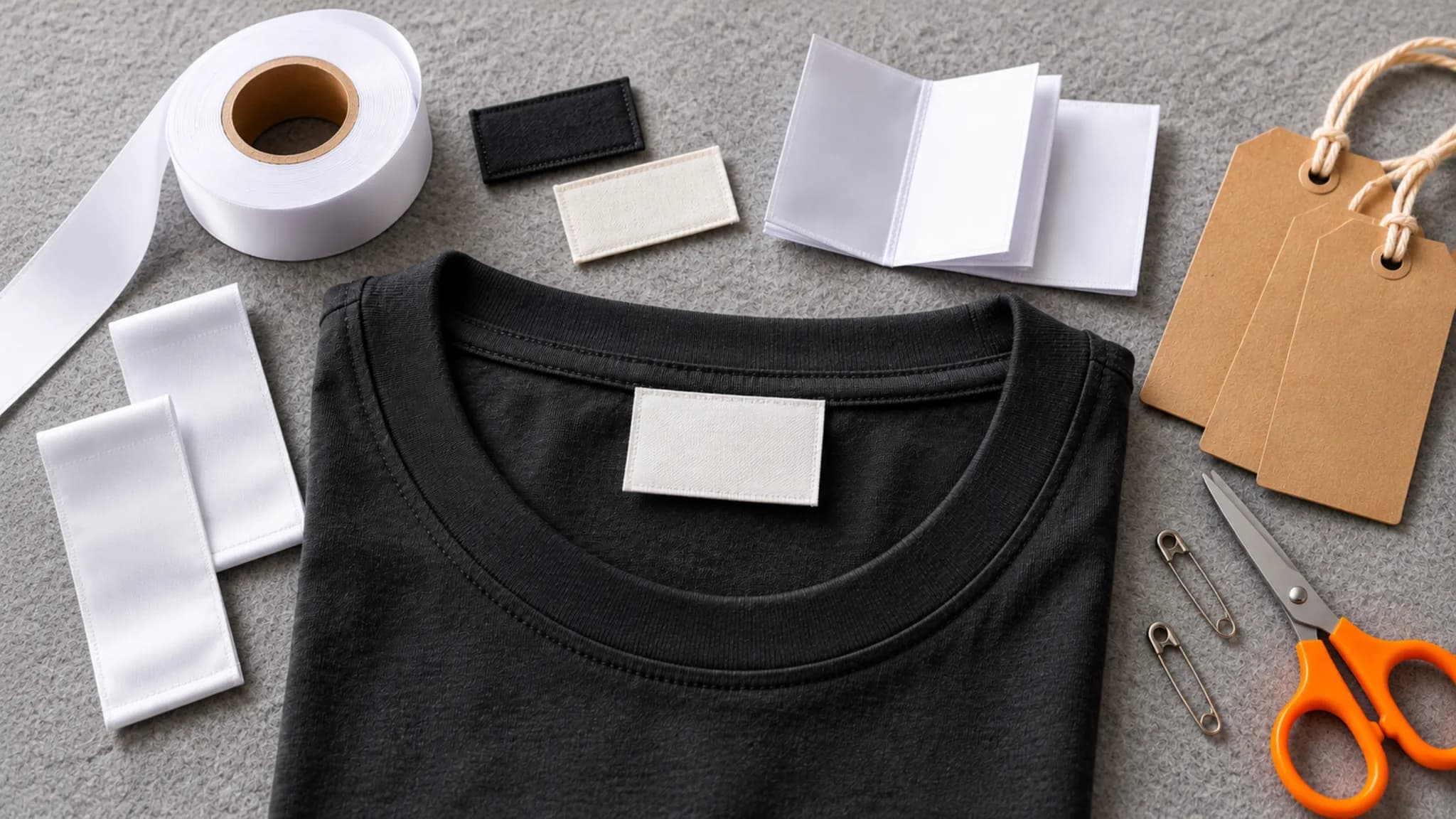
Mandatory permanent information belongs on a sewn-in or printed label, not only on the hang tag, which the customer throws away. Printed (tagless) neck labels are fine, as long as they stay legible after repeated washing.
One label for several markets
If you sell in the US, Canada, the EU and the UK, a single care and content label can usually cover all of them:
- Fibre content in English, French and the other EU languages you need, using each market's fibre names (spandex for North America, elastane for Europe)
- Care symbols plus short care words in English
- "Made in Pakistan", with the French version for Canada
- Your RN number (US) and CA number (Canada)
- Your company name and address, and your EU responsible person
- A style and batch code
Common label mistakes
- "Cotton rich" or "soft blend" instead of real percentages
- "Lycra" or "bamboo" used alone, without the generic fibre name
- Care instructions that do not suit the garment, such as "dry clean only" on a fleece hoodie
- Printed care labels that fade after a few washes
- French missing on labels for Canada
- Country of origin printed only on the hang tag
- Hard, scratchy labels on kids wear, where a soft printed label would be kinder
How we handle labels
Standard label options are included at no extra cost on our orders: neck labels, woven size labels, care labels and hang tags, plus branded packaging if you want it. You send us the legal wording for your market, or ask us for a template to check with your broker, and we produce the labels with your order. See our private label service and our custom branding options, or request a quote.
Key facts
- Fibre content labelling is required in the US, Canada, the EU and the UK.
- The US requires country of origin inside the neck on garments with a neck, plus a company name or RN number and a permanent care label.
- Canada requires fibre content in English and French and a CA number or name and address; care labelling is voluntary.
- The EU requires fibre content in the local language; since 13 December 2024 the GPSR also requires traceability details and an EU responsible person for non-EU makers.
- Australia requires care instructions in English and the country of origin on imported clothing.
- Fibre content tolerance in the US is 3 percentage points.
Frequently asked questions
What must be on a clothing label in the USA?
Fibre content by percentage with generic fibre names, the country of origin, the company name or RN number, and permanent care instructions.
Is a care label required in the EU?
No, care labelling is voluntary in the EU, but fibre content is mandatory and most retailers expect care symbols.
Do I need an RN number?
No. An RN is optional and only issued to US businesses. You can show your company name instead.
What is a CA number?
A Canadian identification number issued by the Competition Bureau. It can be shown on textile labels instead of the dealer's name and postal address.
Can I use a printed tagless label instead of a sewn-in label?
Yes, as long as the information stays legible for the life of the garment. Check it after repeated washing at the sample stage.
Does "Made in Pakistan" have to be on the neck label?
For the US, on garments with a neck, the country of origin must appear on a label inside the centre of the neck. Other markets are more flexible about placement.