Labels and testing
Kids Clothing Testing for Amazon: CPSIA, Flammability and Why the Brand Carries the Duty
· 10 min read · By the QumashLab team
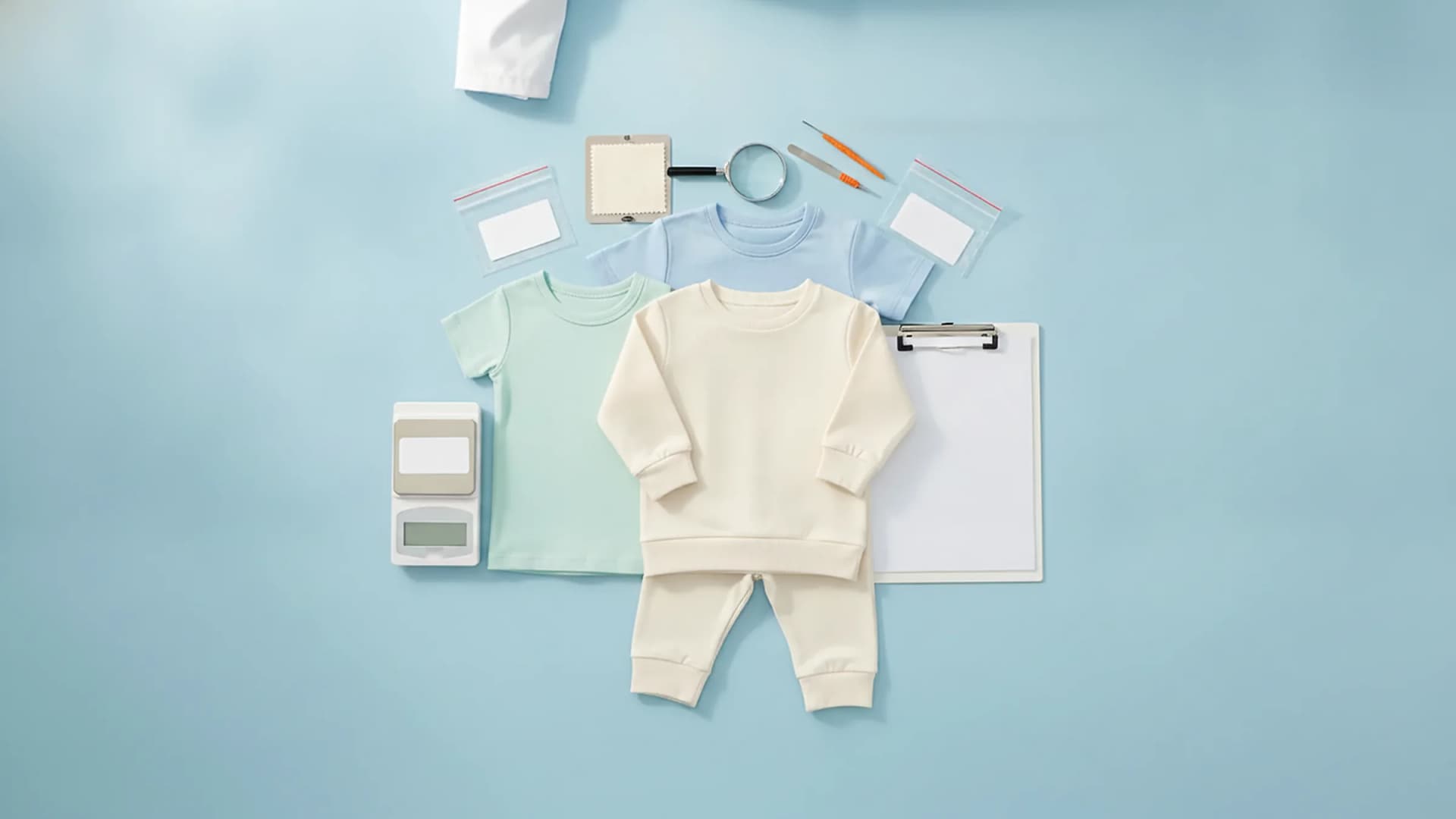
If you sell kids clothing in the United States, on Amazon or elsewhere, the duty to show it is safe sits with your brand, not the factory, under the rules buyers call CPSIA. In most private label set-ups the brand, as importer, issues the Children's Product Certificate, and that certificate has to rest on testing by a laboratory the Consumer Product Safety Commission (CPSC) has accepted, wherever a rule calls for it. Flammability is easy to get wrong: the rule depends on the cut, the fabric and how the garment is marketed. Proper testing is part of the cost of being a brand.
Why the brand, not the factory, carries the CPSIA duty
A children's product is one designed or intended primarily for children 12 or younger, judged from its label, packaging, advertising and CPSC's age guidelines.
Adult clothing needs no CPSC-accepted laboratory. For children's products, where a rule calls for it, a third-party laboratory CPSC has accepted for that rule must test samples, and then the importer (for goods made abroad) or the domestic manufacturer issues the Children's Product Certificate (CPC). A laboratory never issues it and CPSC does not approve it. An importer cannot simply pass along the factory's certificate; it may rely on the factory's testing only with due care and access to the underlying reports. The importer of record is usually the party that must certify, so settle in writing who that is before goods ship.
Flammability: the rule depends on the garment
General clothing, 16 CFR Part 1610. Fabric is classed 1, 2 or 3 by burn time: Class 1 is normal and acceptable, Class 2 (raised-surface fabrics only) is intermediate and may be used, and Class 3, rapid and intense burning, must not be used for clothing.
Many garments need no laboratory test. Plain-surface fabric of 2.6 oz per square yard (88.2 g per square metre) or more is exempt from testing, and so is any fabric made entirely of acrylic, modacrylic, nylon, olefin, polyester or wool, or a mix of these. These are testing exemptions, not exemptions from the rule: the CPC must still cite Part 1610. Raised-surface fabrics such as fleece, terry and flannel are not exempt on weight, and an exposed fleece lining counts even when the outer fabric is exempt. More in our clothing lab testing guide.
Sleepwear is a different, stricter test
Children's sleepwear in sizes 0 to 6X (Part 1615) and 7 to 14 (Part 1616) must be flame resistant: an average char length of no more than 7.0 inches and no specimen burning its full 10 inches, including after 50 launderings. CPSC staff say untreated 100% cotton, silk, rayon and modal typically fail.
Two routes lead back to Part 1610. Infant garments sized 9 months or smaller (not 12) qualify within set length limits and with a size label in months. Tight-fitting garments must stay within a size-by-size dimension table and bear a sewn label reading "WEAR SNUG-FITTING, NOT FLAME RESISTANT" and a yellow hangtag.
Use, not the name on the label, decides what is sleepwear. CPSC weighs suitability for sleep, construction, fabric and how the garment is marketed. Loungewear and similar comfort wear is treated as sleepwear. If a style could be read either way, decide early.
Other tests: what each checks and when it applies
| Test or check | What it checks | When it applies |
|---|---|---|
| Total lead content | At most 100 ppm in any accessible part | Buttons, zips, snaps, metallic threads, transfers and prints; a plain dyed textile needs no lead test |
| Lead in paint and coatings (16 CFR 1303) | At most 0.009% (90 ppm) | Painted trims and print coatings that scrape off |
| Drawstrings (16 CFR 1120) | No hood or neck drawstrings on upper outerwear sizes 2T to 12; limits on waist and bottom cords to size 16 | Upper outerwear and upper clothing; Amazon asks for a test report on waist and bottom cords |
| Small parts (16 CFR 1501) | Parts a child under 3 could swallow | Clothing and buttons are exempt from the test, but detaching snaps can still lead to a recall |
| Phthalates (16 CFR 1307) | 0.1% for eight listed phthalates | Toys and child care articles; bibs and sleepwear for children 3 and under count as child care articles |
| Tracking label | Permanent marks for maker, place, date and batch | Every children's product, on the product and its packaging to the extent practicable (Amazon expects both) |
For cords, snaps and small parts see our kids clothing safety design checklist; for tracking labels, the label requirements guide.
The same question in Canada, the EU and the UK
A Children's Product Certificate is a US concept. In the texts we read, these markets ask for no certificate and no third-party laboratory for ordinary children's clothing, but the brand must still sell safe products.
| Market | Main rule for the brand | Kids clothing points |
|---|---|---|
| Canada | Canada Consumer Product Safety Act; no pre-market approval | Sleepwear regulations to size 14X; textile flammability rules; 90 mg/kg lead limit for children under 14; drawstring notice |
| EU | General Product Safety Regulation (EU) 2023/988, applying since 13 December 2024; a brand selling under its own name counts as manufacturer and keeps technical documentation for 10 years; a brand outside the EU also needs an EU-established responsible operator (authorised representative, importer or, failing those, fulfilment service provider) named on the product or packaging | No CE mark found; EN 14682 for cords; REACH entry 72 limits chemicals in all consumer clothing |
| Great Britain | General Product Safety Regulations 2005 (Northern Ireland follows the EU rule) | Nightwear (Safety) Regulations 1985, children under 13: flammability performance for some nightwear, fire-warning labels for others; check the current text |
A report written for one market's rules does not automatically cover another's.
What Amazon asks of children's clothing sellers
These points come from Amazon's US Seller Central help pages as read in November 2026. They carry no revision date, so check the live requirement.
- Amazon's US category overview lists Apparel as not needing category approval, and for most kids clothing Amazon may request documents at any time through Account Health.
- For children's products it may ask for images of product, packaging, tracking label and warnings, a CPC from the domestic manufacturer or importer, and test reports from a CPSC-accepted laboratory.
- Documents must be original, non-editable and in English; Amazon may not be named as importer; a tracking label must be permanent, not a paper sticker.
- Children's sleepwear, including lounge wear from 9 months to size 14, is stricter. Amazon's policy speaks of applying to list it and asks for the CPC, a CPSC-accepted laboratory report showing Pass or N/A and label images, and sellers report refused applications. Look for an Apply to sell button before you send stock.
- Listing text may not say or imply that CPSC tested, approved or certified a product; CPSC does none of those things.
Amazon is in the chain too: in July 2024 CPSC found it to be a distributor, and so responsible for recalls, of third-party products sold through Fulfilled by Amazon, including children's sleepwear that violated flammability standards. See our Amazon seller page.
What goes wrong without proper testing
- The listing. Amazon may remove listings, suspend listing privileges and withhold payments if requested documents are late.
- The stock. CPSC enforces certificates and can ask Customs to seize goods.
- The law. Selling or importing a product that fails a flammability standard is unlawful, as are issuing a false certificate when due care would have shown it false and subdividing production of a children's product into small quantities to evade third-party testing. Civil penalties apply.
- The brand. CPSC has recalled 100% cotton children's nightgowns sold on Amazon for violating the sleepwear flammability standards.
How we work with you on testing
Third-party lab testing to your market's rules can be arranged on request. On a kids range it works like this.
- You tell us garment types, sizes, markets, sales channels and any style that could count as sleepwear or loungewear.
- A partner laboratory proposes a test list for your styles and market. You and your own compliance adviser confirm which rules apply, and we pass the agreed list to the laboratory.
- You confirm the fabric, trims and print method for each style, and we send samples and materials to the partner laboratory on request (see our sample types guide).
- The laboratory issues its report to the party that ordered the test, normally your brand. Keep it with your purchase order.
- If a result is a fail, the fabric, trim, print or cut has to change and the changed version needs a new test. We can talk through options; a retest is a new test and no pass is promised.
Independent laboratories run the tests and write the reports. QumashLab does not issue certificates, including the Children's Product Certificate: in the US your brand, or whoever is importer of record, issues it from the laboratory's reports. Scope and timing depend on the garment, the market and the laboratory, so they are agreed per order. Testing repeats while you keep producing and after material changes. See our quality page and kids clothing range.
What to prepare before you ask for a quote
- Markets, sales channels and importer of record.
- Sizes and age range, including any style of 9 months or smaller.
- Fabric: fibre content, weight, plain or raised surface (see our kids fabric guide).
- Trims and decoration: buttons, snaps, zips, prints, transfers, drawstrings and cords.
- Whether each style is daywear, loungewear or sleepwear.
Send these through our quote form, mentioning a kids product and your market. For the Gulf or other markets, tell us the country.
This guide explains the main rules from CPSC, eCFR, Amazon and official EU, UK and Canadian sources read in November 2026. It is not legal advice, and rules change. Confirm your product's requirements with a CPSC-accepted laboratory or a compliance specialist, and read the current text at www.cpsc.gov and www.ecfr.gov.
Key facts
- The importer (goods made abroad) or domestic manufacturer issues the US Children's Product Certificate; a laboratory never does.
- Sleepwear in sizes 0 to 14 faces the stricter Parts 1615 and 1616 unless infant or tight-fitting; loungewear counts.
- Amazon may ask for the certificate and laboratory reports at any time; sleepwear needs an application first.
Frequently asked questions
Who issues the Children's Product Certificate (CPC) under CPSIA for kids clothing sold in the US?
The importer for goods made abroad, and the domestic manufacturer for goods made in the US. For a private label brand that is normally the brand, or whoever is importer of record. A laboratory never issues it, CPSC does not approve it, and QumashLab does not issue it.
Does 100% cotton kids clothing need flammability testing?
Plain-surface fabric of 2.6 oz per square yard or more is exempt from testing under 16 CFR 1610, but must still meet the rule. Fleece and other raised-surface cotton is not exempt on weight, and sleepwear is stricter.
Does Amazon require a certificate and test reports before I can list kids clothing?
For most kids clothing there is no up-front approval, but Amazon may request the certificate, reports and label evidence at any time. Children's sleepwear and lounge wear go through a selling application asking for those documents first. Check Seller Central.
Does the testing laboratory have to be in the US?
No. It must be a laboratory CPSC has accepted for the specific rule, wherever it is located. CPSC's public list includes laboratories in many countries, including Pakistan, with differing scopes.
Are small brands and small first orders exempt from testing?
No. A registered small batch manufacturer gets relief only for some rules, and only up to 7,500 units of the same product a year, with the revenue of commonly controlled businesses counted together. Registration is not an exemption: the product must still comply, a CPC is still needed, and some rules, such as lead in paint and small parts, always need a CPSC-accepted laboratory. Amazon says some products must be tested even then.